If you shop online and aren’t using an amazon credit card, you are quite literally leaving free money on the digital checkout table.
Think about it: between daily Amazon purchases, Whole Foods grocery runs, and seasonal sales, the average shopper spends thousands of dollars a year inside this ecosystem. A standard 1.5% or 2% cash-back card barely scratches the surface. The right Amazon credit card, however, can instantly slice 5% to 20% off your total spending while unlocking interest-free financing and instant sign-up bonuses.
Whether you are a Prime loyalist hunting for maximum cash back or a small business owner leveraging corporate cash flow, this guide cuts through the bank fine print. Here is your ultimate blueprint to choosing, comparing, and maximizing the Amazon card ecosystem.
Article Outline
- 1 1. Exclusive Discount Deals & Perks on Amazon Credit Cards
- 2 2. Breakdown of Amazon Credit Card Products
- 3 3. Comparison Matrix
- 4 4. Amazon Credit Card Pros And Cons
- 5 5. Annual Sale of Amazon Credit Card
- 6 6. Explore Related Guides & Deep Dives
- 7 7. Amazon Credit Card Login & Account Management
- 8 Closing Words on Amazon Credit Card
1. Exclusive Discount Deals & Perks on Amazon Credit Cards
Beyond everyday rewards, cardholders unlock special promotional discounts and exclusive financing perks across Amazon’s platform:
-
Instant Welcome Gift Cards: Get an instant Amazon Gift Card (typically ranging from $60 to $200) added to your Amazon balance immediately upon approval—with zero spending requirement.
-
Prime Day & Big Deal Days Cash-Back Surges: During major events like Prime Day or Black Friday, Prime cardholders frequently unlock 10% to 20% total cash back (or up to 7% with No-Rush Shipping) on select categories.
-
Equal Monthly Installments (0% Interest): Spread the cost of large electronics, appliances, or furniture across 6, 12, or 24 equal monthly payments without paying a single dollar in interest.
-
Whole Foods Grocery Savings: Prime Visa holders earn 5% back on every purchase at Whole Foods Market, plus an extra 10% off select sale items in-store.
-
Targeted Category Boosts: Cardholders regularly receive targeted promotional offers (like earning 5% to 9% back on outside spending like gas, dining, and drugstores).
2. Breakdown of Amazon Credit Card Products
                     ┌──────────────────────────────────────────────┐
                     │          Amazon Credit Card Family           │
                     └──────────────────────┬───────────────────────┘
                                            │
         ┌──────────────────┬───────────────┴───────────────┬──────────────────┐
         ▼                  ▼                               ▼                  ▼
┌─────────────────┐┌─────────────────┐             ┌─────────────────┐┌─────────────────┐
│ Prime Visa      ││ Amazon Visa     │             │ Prime Store Card││ Business Cards  │
│ (Chase)         ││ (Chase)         │             │ (Synchrony)     ││ (Amex / Chase)  │
└────────┬────────┘└────────┬────────┘             └────────┬────────┘└────────┬────────┘
         │                  │                               │                  │
         ▼                  ▼                               ▼                  ▼
   Unrestricted       Everywhere Card                  Amazon-Only         B2B Expense
   5% Cash Back        3% Cash Back                    5% / Financing       & Cash Flow
Prime Visa (Issued by Chase)
The Prime Visa is Amazon’s flagship consumer credit card. Issued by Chase, this open-loop Visa Signature card earns an uncapped 5% cash back on Amazon.com, Whole Foods Market, and Chase Travel for active Prime members. It also earns 2% back at restaurants, gas stations, and local transit, plus 1% back everywhere else. With no foreign transaction fees, secondary rental car coverage, and extended warranty protection, it serves as a powerful everyday primary card.
Amazon Visa (Issued by Chase)
Designed for non-Prime shoppers, the standard Amazon Visa delivers solid everyday reward rates without requiring an active Prime subscription. It earns 3% cash back at Amazon.com, Whole Foods, and Chase Travel, 2% back on dining, gas, and transit, and 1% back on all other purchases. If you ever join Prime later, the card automatically upgrades to the Prime Visa structure, bumping your Amazon earn rate to 5%.
Amazon Store Card (Issued by Synchrony Bank)
The Amazon Store Card is a closed-loop card issued by Synchrony Bank, meaning it functions exclusively on Amazon.com and select affiliated properties. Prime members holding the Amazon Prime Store Card earn 5% cash back on Amazon purchases or can opt for interest-free Equal Monthly Payment financing on larger items. Because store card underwriting is often more accessible, it is a top pick for shoppers with fair-to-good credit.
Amazon Business Credit Cards (Issued by American Express & Chase)
Built for sole proprietors and businesses, Amazon partners with American Express and Chase to provide specialized purchasing power:
-
Amazon Business Prime American Express Card: Offers Prime businesses a choice between 5% cash back on the first $120,000 in eligible purchases each calendar year (then 1%) OR 90-day extended 0% interest payment terms.
-
Amazon Business American Express Card: Gives non-Prime businesses 3% cash back on the first $125,000 annually (then 1%) OR 60-day extended payment terms.
3. Comparison Matrix
| Amazon Credit Card Name | Annual Fee | Cash Back Rate | Issuer | Credit Score Tier Required |
| Prime Visa | $0 ($139/yr Prime membership required) |
|
Chase | Good to Excellent (670–850) |
| Amazon Visa | $0 |
|
Chase | Good to Excellent (670–850) |
| Amazon Prime Store Card | $0 ($139/yr Prime membership required) |
|
Synchrony Bank | Fair to Good (640–740) |
| Amazon Business Prime Amex | $0 ($139/yr Prime membership required) |
|
American Express | Good to Excellent (670–850) |
4. Amazon Credit Card Pros And Cons
The side-by-side pros and cons for all primary Amazon credit card options are unified into a single comparative table:
|
Amazon Credit Card Name |
Pros | Cons |
|---|---|---|
| Prime Visa (Chase) |
|
|
| ChAmazon Visa (Chase) |
|
|
| Amazon Prime Store Card (Synchrony) |
|
|
| Amazon Prime Secured Card (Synchrony) |
|
|
5. Annual Sale of Amazon Credit Card
Here is the Annual sale trends and growth of amazon credit card
Amazon Credit Card Annual Sales & Growth Trends:
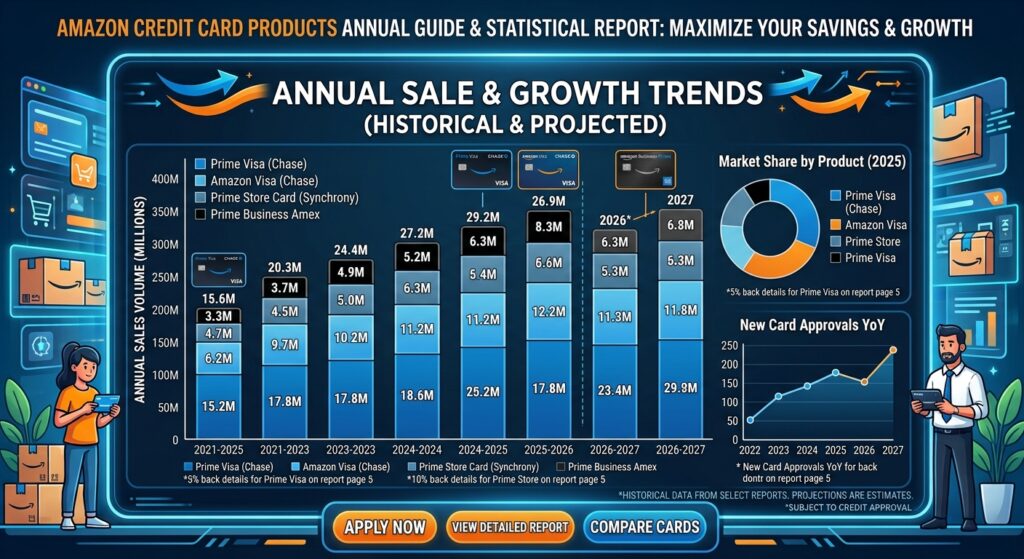
- Main Trend (Annual Sales Volume):
- Prime Visa (Chase) drives the largest share of overall volume, steadily expanding year-over-year.
- Amazon Visa (Chase) and Prime Store Card (Synchrony) maintain consistent growth, appealing to non-Prime shoppers and financing-focused buyers, respectively.
- Prime Business Amex represents a specialized, growing slice of volume driven by enterprise and SMB purchasing.
- Market Share Distribution:
- Prime Visa (Chase) holds the dominant majority of total card portfolio volume.
- Amazon Visa and Prime Store Card hold significant secondary shares, while
- Prime Business Amex rounds out the commercial tier.
- Approval & Account Growth (YoY): Shows a continuous upward trajectory in New Card Approvals, reflecting strong ongoing consumer and business demand for Amazon co-branded financial products.
6. Explore Related Guides & Deep Dives
To learn more about specific card mechanics, review these supporting resources before making a final decision:
- Looking for a detailed breakdown of benefits, travel perks, and insurance coverage? [Read our full Amazon Prime Visa Review].
- Curious whether your credit profile qualifies for instant approval? [Read our guide on Credit Score Requirements for Amazon Credit Cards].
- Undecided between an open-loop Chase card and a Synchrony store card? [See our head-to-head analysis: Prime Visa vs. Amazon Store Card].
7. Amazon Credit Card Login & Account Management
Managing your amazon credit card account differs slightly from standard online shopping because Amazon does not store or process your monthly credit statements directly. Because Amazon cards are issued by partner banks (Chase for Visa cards, Synchrony Bank for Store Cards, and American Express for Business cards), cardholders manage payments, monitor transaction histories, and update billing settings through the respective issuing bank’s portal or mobile app.
While you can monitor earned reward points directly within your Amazon.com account settings, executing monthly bill payments requires logging into Chase.com, Synchrony’s Amazon portal, or Amex.com.
For a complete step-by-step guide on paying your bill, setting up autopay, and accessing your online account, check out our dedicated Amazon Credit Card Login Guide.
Closing Words on Amazon Credit Card
If you shop on Amazon regularly, skipping a co-branded card means leaving substantial cash back and financing perks on the table. Evaluate your credit profile, match the card to your spending habits, and start turning your everyday online checkout into automatic savings.