The Latest Quantum Computing Breakthroughs: From Lab Experiments to Practical Reality

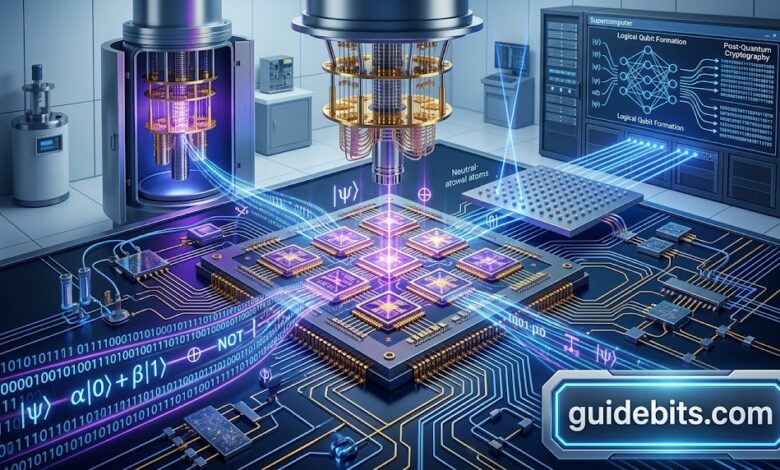
For decades, quantum computing belonged to the domain of theoretical physics. It was defined by delicate laboratory setups, esoteric math, and headlines promising a revolution that always seemed twenty years away. That era is officially over. We have entered a pivotal transition phase: moving past the Noisy Intermediate-Scale Quantum (NISQ) era and stepping squarely into the age of fault-tolerant quantum computing. Instead of asking whether quantum mechanics can outperform classical supercomputers on abstract mathematical riddles, the conversation among researchers, tech executives, and engineers has dramatically shifted. Today, the focus is on scaling logical qubits, executing high-fidelity quantum error correction, deploying novel neutral-atom hardware architectures, and hardening global infrastructure against future quantum threats. The latest quantum computing breakthroughs are reshaping what is computationally possible across drug discovery, logistics, materials science, and cryptography. Here is an in-depth breakdown of the engineering milestones driving this quantum shift.
Article Outline
- 1 Key Takeaways
- 2 Breakthrough #1: Quantum Error Correction & Logical Qubits
- 3 Breakthrough #2: Novel Qubit Architectures (Neutral Atoms & Trapped Ions)
- 4 Breakthrough #3: Quantum Utility & Real-World Deployments
- 5 Breakthrough #4: Post-Quantum Cryptography (PQC) Standardization
- 6 Traditional NISQ vs. Modern Fault-Tolerant Quantum Systems
- 7 Future Outlook & Challenges Ahead
- 8 Frequently Asked Questions (FAQ)
Key Takeaways
- Quantum Error Correction Is Real: Hardware providers have officially crossed the physical-to-logical qubit threshold, demonstrating that larger quantum error-correcting codes actively suppress system noise.
- Neutral Atoms Are Scaling Fast: Neutral-atom arrays and optical tweezer technology have emerged as formidable rivals to superconducting circuits, enabling thousands of highly connected physical qubits without extreme cryogenic overhead.
- Utility Replaces Supremacy: The industry has moved beyond arbitrary “quantum supremacy” benchmarks toward verifiable quantum utility using hybrid quantum-classical supercomputing stacks.
- PQC Migration Is Mandatory: With the NIST release of official Post-Quantum Cryptography (PQC) standards, enterprises must immediately begin upgrading legacy encryption to protect against future decryption risks.
Breakthrough #1: Quantum Error Correction & Logical Qubits
Historically, the Achilles’ heel of quantum computing has been environmental decoherence. Stray thermal fluctuations, electromagnetic radiation, and physical imperfections cause physical qubits to lose their delicate state, introducing devastating calculation errors within microseconds.
For years, adding more physical qubits simply meant adding more noise. The biggest tipping point in quantum history is breaking through this bottleneck via fault-tolerant quantum computing and quantum error correction (QEC).
Crossing the Error Threshold
To build a reliable quantum computer, researchers group multiple noisy physical qubits into a single, highly resilient logical qubit. Through active surface codes and error detection algorithms, the system monitors physical qubits and fixes errors in real time without destroying the underlying quantum information.
A landmark milestone in this domain occurred when Google Quantum AI demonstrated the “below-threshold” regime on its Willow chip. By scaling up the surface code size across its 105 superconducting qubits, Google proved empirically that growing the physical qubit cluster decreased the logical error rate exponentially.
Why Exponential Error Suppression Changes Everything
Rather than being bogged down by noise as hardware grows, systems operating below the threshold become cleaner and more stable as they scale.
Simultaneously, pioneers like IBM, Quantinuum, and Harvard/QuEra have successfully demonstrated multi-logical-qubit operations, proving that complex quantum gates can be executed directly between error-corrected logical qubits. This shifts the industrial roadmap from brute-force physical qubit counts to the creation of high-fidelity, long-lived logical qubits capable of running millions of computational steps.
Breakthrough #2: Novel Qubit Architectures (Neutral Atoms & Trapped Ions)
While superconducting circuits (transmon qubits cooled near absolute zero) spearheaded early quantum research, alternative hardware architectures have achieved massive technological leaps.
+--------------------------------------------------------------------------------------------------+
|                                  QUANTUM HARDWARE MODALITIES                                     |
+-----------------------------------+--------------------------------------------------------------+
| Superconducting Circuits          | Transmon qubits on microchips; near absolute-zero cooling.   |
+-----------------------------------+--------------------------------------------------------------+
| Neutral-Atom Arrays               | Neutral atoms held by lasers (optical tweezers); highly      |
|                                   | scalable at room/near-room temperature.                      |
+-----------------------------------+--------------------------------------------------------------+
| Trapped Ions                      | Charged atoms controlled by electromagnetic fields; highest  |
|                                   | gate fidelity and longest coherence times.                   |
+-----------------------------------+--------------------------------------------------------------+
Neutral-Atom Quantum Arrays: Nature’s Identical Qubits
Companies like QuEra Computing, along with academic laboratories at Harvard and Caltech, have rapidly advanced neutral-atom quantum arrays.
-
Optical Tweezers: Highly focused laser beams trap individual neutral atoms (such as Rubidium or Cesium) in 2D and 3D geometric grids.
-
Rydberg States: Shining specific laser pulses excites the outer electrons of these atoms into massive “Rydberg states,” allowing them to interact over long distances and execute multi-qubit logic gates on demand.
-
Dynamical Reconfigurability: Unlike fixed superconducting wires printed on a physical silicon wafer, laser tweezers can physically move atoms around mid-circuit. This flexibility enables all-to-all connectivity between qubits, dramatically reducing circuit depth and software overhead.
Neutral-atom arrays scale naturally because all atoms of a given isotope are inherently identical in nature. This avoids the manufacturing variations that affect custom-fabricated chips. Systems supporting thousands of neutral-atom physical qubits in compact chambers are now actively operating.
Trapped-Ion Fidelity
Concurrently, trapped-ion systems (pioneered by Quantinuum) continue to set record benchmarks for gate fidelity—achieving two-qubit gate accuracies exceeding 99.9%. High gate fidelity means fewer physical qubits are needed to construct a stable logical qubit, proving that architectural diversity is driving overall industry progress.
Breakthrough #3: Quantum Utility & Real-World Deployments
For years, the technology sector was fixated on “quantum supremacy”—performing an engineered benchmark calculation on a quantum processor faster than on a classical supercomputer. Today, the industry has graduated to quantum utility and quantum-inspired hybrid computing.
Quantum processors (QPUs) are no longer isolated lab instruments. Instead, they are being integrated into high-performance computing (HPC) data centers alongside traditional CPUs and GPUs.
                                +----------------------------------+
                                |  Classical Applications & Data   |
                                +----------------------------------+
                                                 |
                                                 v
                                +----------------------------------+
                                | Hybrid Orchestration Layer       |
                                | (e.g., NVIDIA CUDA-Q Platform)   |
                                +----------------------------------+
                                       /                    \
                                      v                      v
                       +------------------------+  +-------------------+
                       | GPU Supercomputer      |  | Quantum Processor |
                       | (Heavy Matrix Math / AI)| | (QPU - Subroutines)|
                       +------------------------+  +-------------------+
Hybrid Orchestration Platforms
Frameworks like NVIDIA CUDA-Q and open-source orchestration stacks allow developers to write unified code that offloads specific subroutines to a QPU while running massive parallel calculations on classical GPU clusters.
High-Impact Enterprise Applications
1. Material Science & Drug Discovery
Simulating the quantum-mechanical interactions of molecules requires exponentially more computing power as molecules grow larger. Hybrid quantum systems can directly model chemical bond formation, nitrogen-fixation catalysts, and complex protein-ligand binding that would take classical supercomputers millennia to approximate.
2. Portfolio Optimization & Risk Modeling
Major financial institutions are running hybrid algorithms to optimize multi-asset portfolios, model complex derivative pricing, and perform real-time fraud detection. Quantum-inspired algorithms running on hybrid QPUs process millions of fluctuating market variables simultaneously, uncovering non-linear risk patterns.
3. Supply Chain & Logistics Optimization
From airline route scheduling to global supply-chain routing under dynamic constraints, quantum annealing and gate-based hybrid solvers tackle combinatorial optimization problems far beyond the reach of classical linear programming.
Breakthrough #4: Post-Quantum Cryptography (PQC) Standardization
As quantum computers become more capable, they introduce a fundamental threat to global cybersecurity. Modern internet encryption—including RSA and Elliptic Curve Cryptography (ECC)—relies on the mathematical difficulty of factoring large integers or solving discrete logarithms.
Using Shor’s Algorithm, a sufficiently large fault-tolerant quantum computer could break these public-key encryption schemes in a matter of hours.
+---------------------------------------------------------------------------------------------------+
|                                 THE "HARVEST NOW, DECRYPT LATER" THREAT                           |
+---------------------------------------------------------------------------------------------------+
|  [ Adversary ] ===> Intercepts & Stores Encrypted Data Today (SSL/TLS, Financial Records)         |
|                                       |                                                           |
|                                       v (Saves data until Fault-Tolerant QPU arrives)             |
|  [ Future QPU ] ==> Runs Shor's Algorithm ===> Unlocks Legacy Keys ===> Decrypts Master Files     |
+---------------------------------------------------------------------------------------------------+
The “Harvest Now, Decrypt Later” Threat
State actors and cybercriminals are actively engaging in Harvest Now, Decrypt Later (HNDL) attacks. Adversaries intercept and archive encrypted sensitive data today—such as diplomatic communications, medical records, and financial transaction histories—intending to decrypt it once a cryptographically relevant quantum computer (CRQC) becomes available.
NIST PQC Standards Implementation
To counter this threat, the National Institute of Standards and Technology (NIST) finalized its first official Post-Quantum Cryptography (PQC) standards:
- FIPS 203 (ML-KEM): Based on Module-Lattice Key Encapsulation, designed for general encryption and secure key exchanges.
- FIPS 204 (ML-DSA): Module-Lattice Digital Signature Algorithm for protecting identity verification and authentication protocols.
- FIPS 205 (SLH-DSA): Stateless Hash-Based Digital Signature Algorithm, serving as a mathematically distinct backup signature method.
Global enterprises, cloud providers, and government agencies have begun active migration strategies. Upgrading software stacks to post-quantum standards ensures that data remains secure long before a machine capable of breaking RSA is built.
Traditional NISQ vs. Modern Fault-Tolerant Quantum Systems
To summarize this multi-year evolution, the table below compares the early era of noisy quantum hardware with today’s fault-tolerant architectures.
| Attribute | Traditional NISQ Systems (2018–2023) | Modern Fault-Tolerant Systems (Current & Beyond) |
| Primary Qubit Focus | Raw physical qubit counts | Error-corrected logical qubits |
| Error Rates | High physical noise ($10^{-2}$ to $10^{-3}$) | Exponentially suppressed logical error rates |
| Hardware Modalities | Early superconducting chips & fixed trapped ions | Advanced superconducting, neutral-atom arrays, and optical tweezers |
| Connectivity | Fixed nearest-neighbor physical connections | Dynamic laser reconfigurability & all-to-all qubit coupling |
| Benchmarking Metric | Abstract Quantum Supremacy / RCS tests | Quantum Utility, verifiable advantage, and real-world algorithm speedups |
| Software Stack | Isolated standalone quantum scripts | Hybrid CPU/GPU/QPU co-processing (e.g., CUDA-Q) |
| Security Context | Theoretical discussions around RSA vulnerability | Active deployment of NIST PQC standards (ML-KEM, ML-DSA) |
Future Outlook & Challenges Ahead
Despite these massive leaps, the road to multi-million physical qubit systems still presents engineering hurdles:
- Cryogenic & Control Infrastructure: Superconducting systems require massive dilution refrigerators to operate at millikelvin temperatures. Scaling these requires innovative chip interconnects and miniaturized control electronics to manage thermal loads.
- Laser Precision in Atom Arrays: Neutral-atom platforms must maintain optical control over tens of thousands of individual beams without phase drift or crosstalk.
- Software & Algorithmic Compilation: Converting classical enterprise software problems into quantum-native representations remains complex. Developers must design algorithms that maximize logical gate depth while minimizing runtime overhead.
Over the coming years, expect closer integration between Artificial Intelligence and Quantum Computing. AI models are already being deployed to optimize real-time quantum error correction, control laser positioning in neutral-atom arrays, and design better quantum algorithms. In turn, fault-tolerant QPUs will eventually accelerate AI training loops by processing complex linear algebra at speeds unattainable by classical silicon.
Frequently Asked Questions (FAQ)
What is the biggest breakthrough in quantum computing right now?
The single most impactful breakthrough is verifiable quantum error correction crossing the physical-to-logical threshold. Hardware providers have proven that adding physical qubits to an error-correcting surface code actively reduces the overall logical error rate, paving the clear path toward scale.
What is the difference between a physical qubit and a logical qubit?
A physical qubit is a single physical quantum component (a superconducting circuit, trapped ion, or neutral atom) prone to environmental noise. A logical qubit is a virtual qubit created by grouping many physical qubits together using error-correcting codes, allowing it to store and process quantum information reliably without data loss.
When will quantum computing break RSA encryption?
Breaking modern 2048-bit RSA encryption requires thousands of error-free, fault-tolerant logical qubits (which translates to millions of stable physical qubits). While this capability remains years away, the threat of “Harvest Now, Decrypt Later” attacks makes migrating to NIST’s newly standardized Post-Quantum Cryptography (PQC) an urgent enterprise priority today.
How do neutral-atom quantum computers work?
Neutral-atom quantum computers use optical tweezers—tightly focused laser beams—to trap individual neutral atoms in place. Lasers control and manipulate these atoms, exciting them into high-energy Rydberg states to perform quantum logic operations and entangle qubits with high connectivity.
More on Guidebits.com